
Gorilla Trekking: How It Really Works
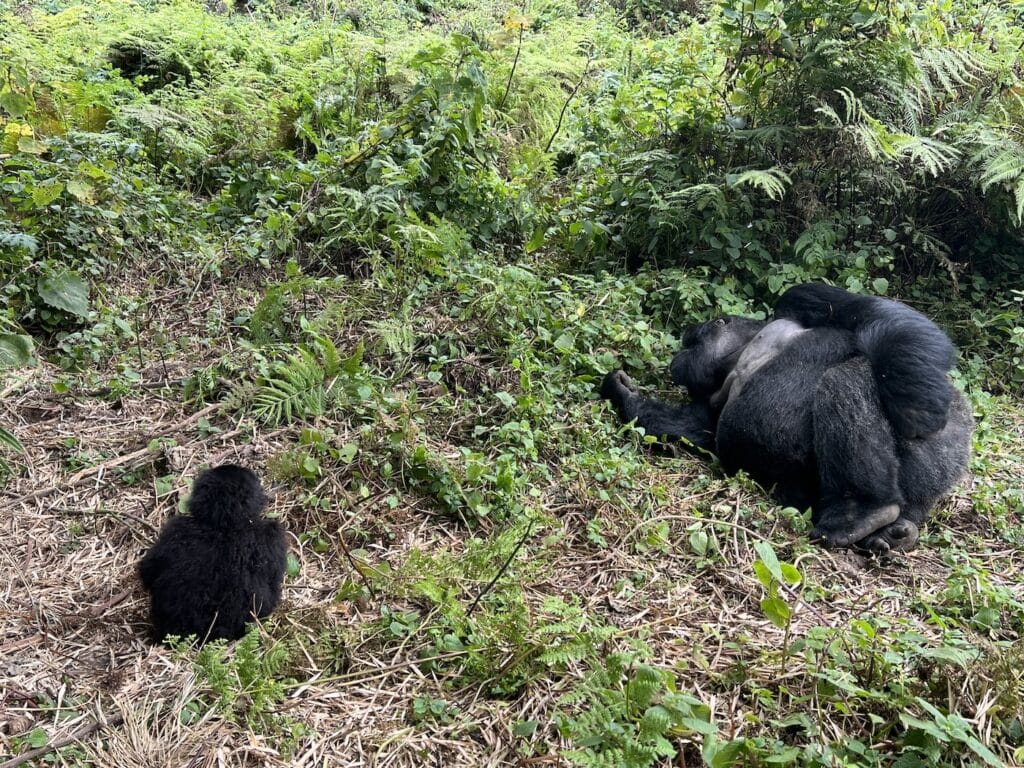
Gorilla trekking isn’t something most people have a reference point for, which is where the questions usually start. Not whether it’s worth it, almost everyone agrees on that, but how the day actually works and what it really feels like once you’re there. For me, this trip had been a long time coming. I’d wanted to do this since I first watched Gorillas in the Mist years ago, and it did not disappoint.
There’s real excitement in the air once you arrive. You’re checking in, waiting to hear which group you’ve been placed in, and that anticipation builds while guides walk everyone through the plan for the day. There’s time to ask questions and get comfortable before heading out, but nobody’s exactly calm. Everyone there has been waiting for this moment for a while, myself included.
Where Gorilla Trekking Takes Place
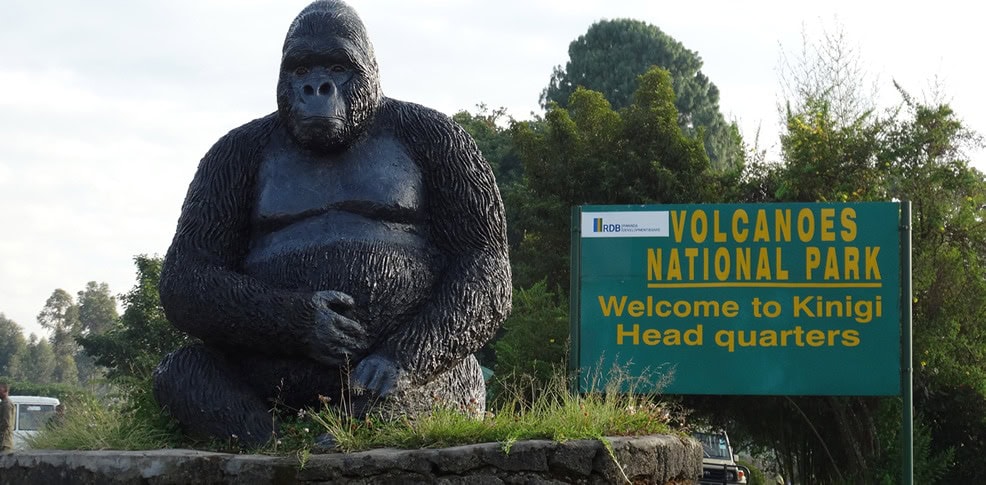
All gorilla trekking in Rwanda happens in Volcanoes National Park, in the far north of the country right up against the borders of Uganda and the Democratic Republic of Congo. There’s no fencing between the three countries out in these mountains, and some peaks, like Sabyinyo, actually sit right on the tripoint where all three meet. On a guided trek this is never an issue, since your rangers know exactly where you are at all times, but it’s part of why wandering off on your own out here would be a genuinely bad idea. It wouldn’t take much to cross into DRC without realizing it. To get to the park from Kigali, you’re looking at about a ninety minute drive to the town of Musanze, then a short hop over to Kinigi, where the trek actually begins.
This park is home to more gorilla families than that, but only ten are habituated for tourism, meaning those are the ones open to visitors, each led by at least one silverback and made up of females and youngsters. Susa is the largest, with close to forty members, and it’s also one of the toughest treks since that family tends to range high into the mountains. Sabyinyo is smaller and much easier to reach, led by a massive silverback named Guhonda. Amahoro, Agashya, Kwitonda, Umubano, and Hirwa round out some of the others, each with its own personality and its own difficulty level. Your guides assign you to a family the morning of your trek based on your fitness level, not the other way around, which takes a lot of the guesswork off your plate.
Trackers head out before sunrise each day to locate where the gorillas are, which is how trekking groups are able to find them without disrupting their normal routines. The gorillas are fully wild, but they’re accustomed to human presence under very specific conditions. That’s the whole balance this program is built on.
Permits, Rules, and What to Bring
This is the part people often don’t realize until they start planning. Each day, only ten gorilla groups are visited, and only eight people are allowed per group, which means just eighty people total are allowed to see gorillas in Rwanda on any given day. Every group gets one hour with their assigned family, and those limits aren’t flexible. Fewer people in the forest means less stress on the gorillas, lower risk of illness passing between species, and a system that actually works long term.
A Rwanda gorilla trekking permit runs $1,500 per person, and that price tag is intentional. It caps the number of daily visitors, but it also funds veterinary care and anti poaching patrols for the gorillas, ranger and tracker salaries, and community projects in nearby villages, including schools and healthcare. When people living near the park see a direct benefit from protecting gorillas, protecting them becomes something everyone has a stake in, and it’s a big part of why Rwanda’s mountain gorilla population has actually grown over the past few decades instead of shrinking. With only eighty permits available per day across the entire park, this isn’t something to leave until the last minute either. Permits routinely sell out three to six months in advance, especially during the dry seasons from June through September and December through February, so the smartest approach is to lock in your permit first and build the rest of your Rwanda trip around it.
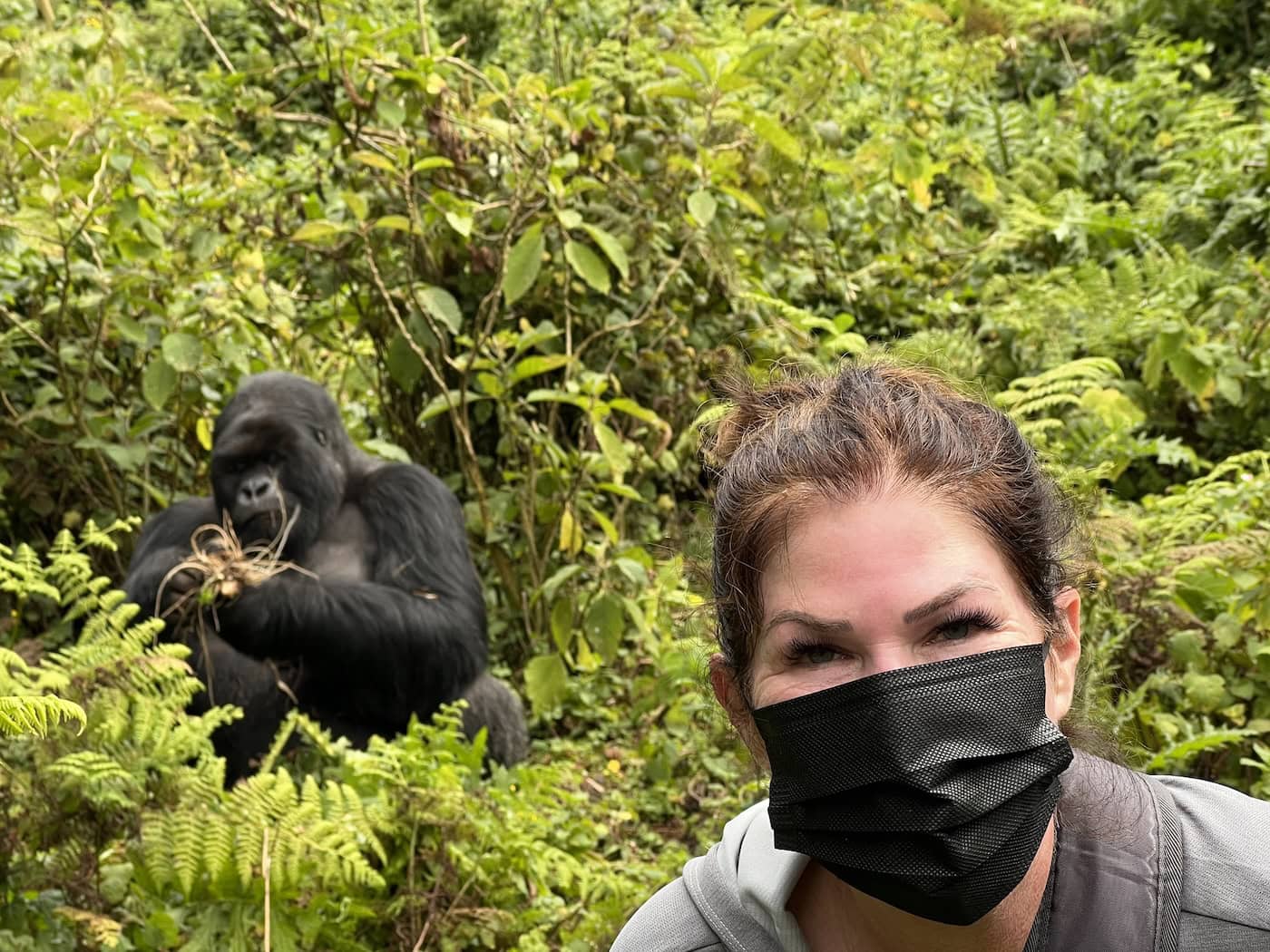
Rwanda enforces gorilla trekking rules seriously, and once you’re there, it makes complete sense. You’re required to keep a distance of at least seven meters from the gorillas, stay together as a group, follow your guide’s instructions exactly, wear a mask while you’re with them, and skip the trek entirely if you’re showing any signs of a cold or other contagious illness. The minimum age for trekking is fifteen, with no exceptions. Gorillas share a huge percentage of our DNA and are vulnerable to human illness in a way that genuinely threatens the species, so these rules protect them and make sure this experience remains possible for the next traveler after you. It doesn’t feel restrictive once you’re standing there. It feels responsible.
As for what to bring, long sleeves and long pants in neutral colors are a must, both for the nettles in the underbrush and to keep a lower profile near the gorillas. Sturdy hiking boots make a real difference on the muddy stretches, and I’d never go without rain gear, since the weather around Musanze shifts constantly between sun and rain, even in the same afternoon. It also gets genuinely cold in the evenings at that elevation, so pack for that too. Bring water and a light snack, and your camera, though flash isn’t allowed once you’re with the gorillas. You don’t need to be in great shape for this. You just need to be able to walk for an extended period, balance on slippery rocks and muddy slopes, cross a few small streams, and handle some light climbing depending on which difficulty level you choose. The guides adjust the pace to the group, and porters are there to help if you need it.
What Trekking Day Is Actually Like
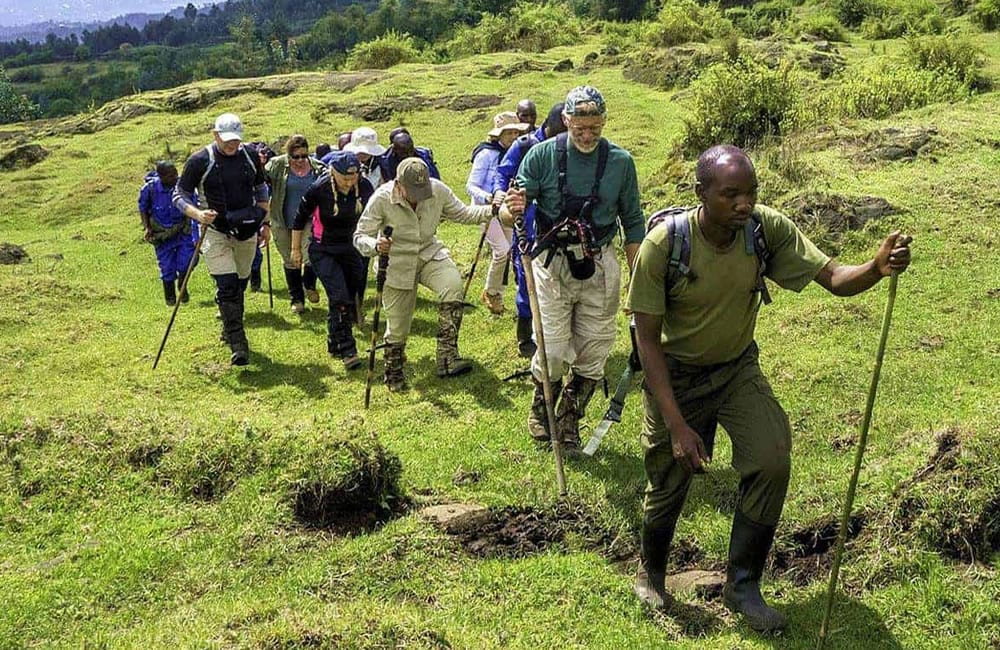
After the morning briefing at the park headquarters in Kinigi, groups are assigned based on fitness level and where the gorilla families are located that day. Each group is capped at eight paying tourists, and by the time you actually set off, it’s a lot more than eight people. Every one of us had our own porter, plus guides and a ranger leading the way, so the trekking party was sizable even though the tourist group itself stays small.
The hike itself varies a lot, and you actually get some say in that. When you book, you choose between easy, medium, or challenging, and that choice determines which gorilla family you’re likely to be paired with, since different families live at different points on the mountain. These times are approximate and only cover the hike in, not the hour with the gorillas or the hike back down. An easy hike usually runs thirty minutes to an hour and a half one way. Medium tends to be two to three hours one way and sits higher up the slope. Challenging is four hours or more one way, with real steep climbing involved. I chose medium for mine. I’d done a challenging chimpanzee trek just two days before, and my legs made it very clear they were not interested in another brutal climb so soon. It ended up being the right call too, since the gorilla trek was actually easier than the chimp trek had been. The climb was gradual enough that my heart never felt like it was going to pop out of my chest, even as we kept working our way higher through thick forest. The gorillas do move around, but always within the range where that family lives, so your guides have a good sense going in of roughly how far you’ll need to go. You’re hiking at elevation too, anywhere between about 2,500 and 4,000 meters, so the air is thinner than you might expect and parts of the ground can be rocky and uneven.
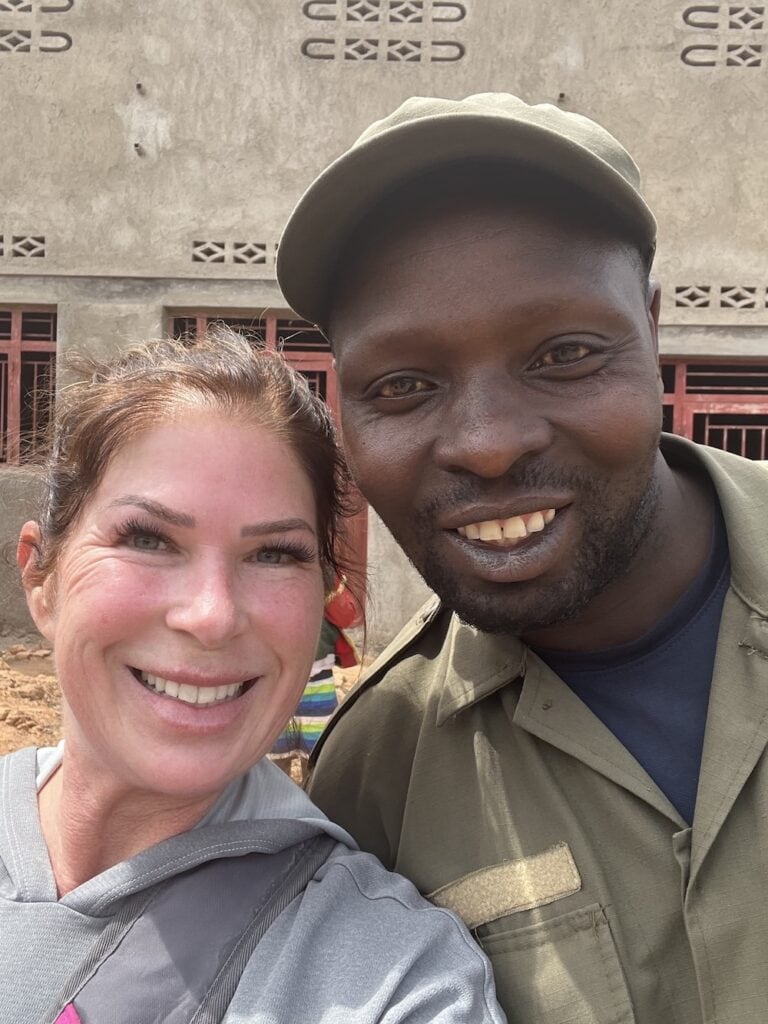
My trekking group that day was made up entirely of Americans, people from California, Oregon, Arizona, and Texas, which made for easy conversation once we got moving. After our briefing with our guide, Placide, and hiring porters at the trailhead, we set off. The trek started through farmland, field after field, before we ever reached the tree line and entered the actual forest. My porter, Alphonse, stayed right next to me the whole way in case I needed a hand, and on the trickier, rockier stretches he’d just reach back and grab my hand before I even asked.
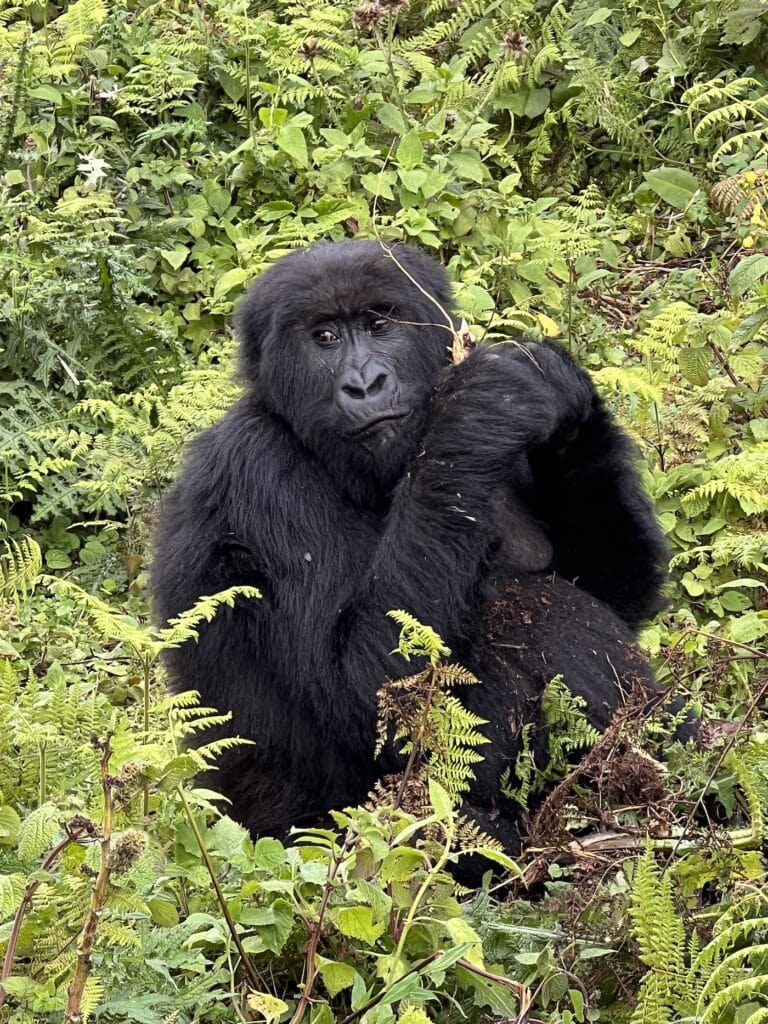
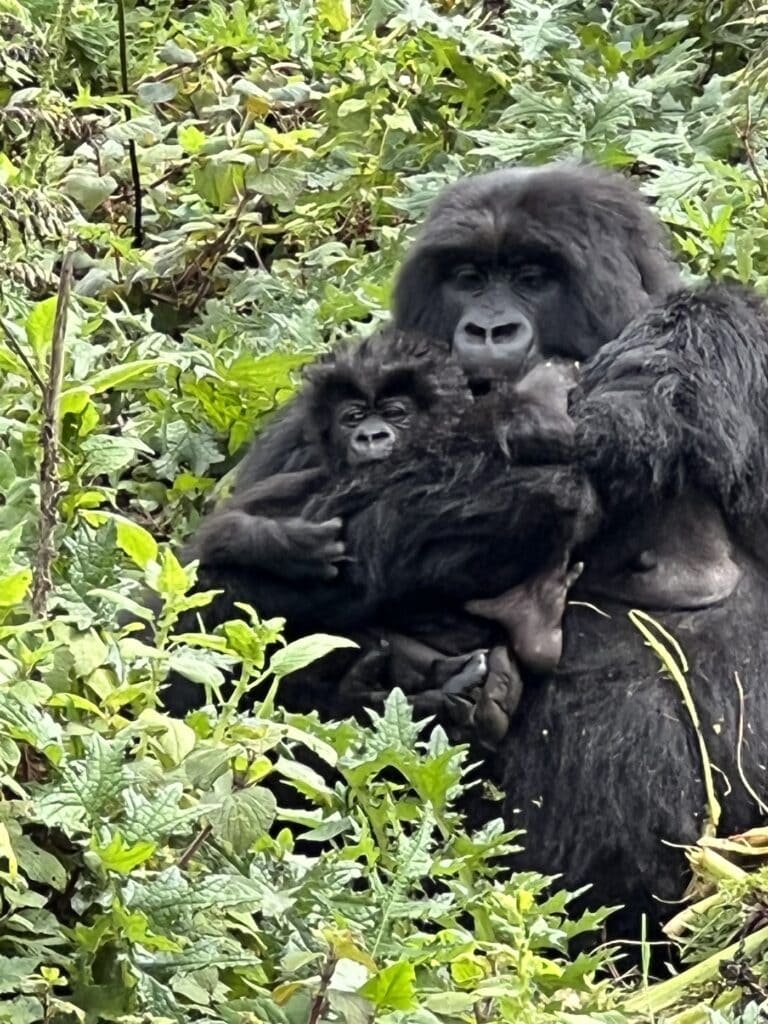
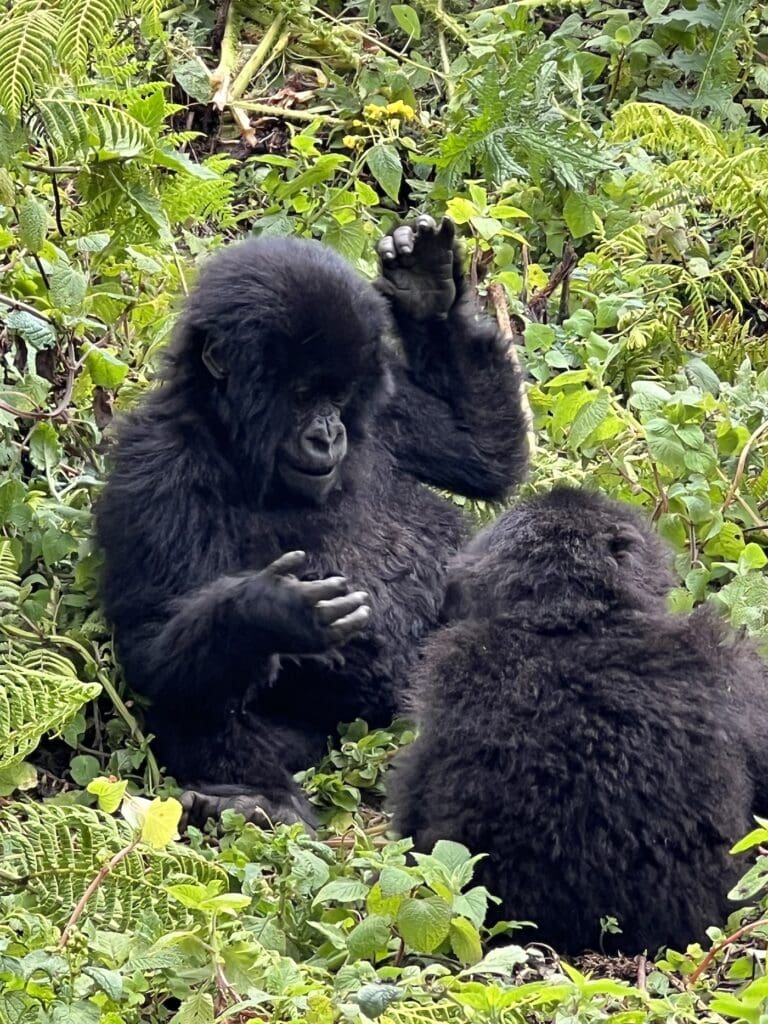
Eventually Placide let us know the trackers had located the family and we were close. We took off our backpacks, left our walking sticks behind, and put on masks. We pushed through one more stretch of tall grass and brush, and then there they were, an opening on the side of the hill with an entire family eating their breakfast. I genuinely don’t have the words for that first moment. There was the silverback, several females, five juveniles who looked to be around two or three years old tumbling over each other, and one mother cradling an infant that couldn’t have been more than three weeks old.
We spread out and spent the hour watching, filming, and photographing. The gorillas moved freely the whole time, sometimes wandering surprisingly close to us, and if one lingered nearby too long, our ranger would quietly have us step back a few feet to give it space. That hour disappeared faster than any hour I can remember, and then we were hiking back down through the same farmland we’d crossed that morning. I remember feeling almost giddy on that walk back, just full of joy and gratitude that I actually got to be there, watching a family of critically endangered gorillas go about their morning like I was nothing more than part of the scenery. Years of wanting to do this, and it turned out to be even better than I imagined.
Thinking About Gorilla Trekking in Rwanda?
This is one of those experiences where the small details really matter. Permits, timing, fitness, and how the trek fits into the rest of your itinerary all shape how the day actually goes. There are fewer than a thousand mountain gorillas left in the world, and roughly four hundred of them call Volcanoes National Park home. Getting to spend an hour with a small piece of that population is not something I take lightly, and I still think about it more than almost anything else I’ve done. I feel incredibly lucky that I got to see them, and grateful to everyone, the guides, the trackers, the rangers, the whole conservation effort behind it, who made that hour possible. I would love to help you plan a trip that gets you there too.
If you’re ready to start mapping out a Rwanda itinerary of your own, reach out and let’s talk through what your trip could look like.